
-
Oct, Tue, 2026

Parts of a Beehive: A Practical Guide
A beehive is a set of simple parts that gives a honeybee colony a dry, manageable home. The names can be confusing because a box may be described by its physical size and by the job it is doing in that particular hive. Keeping those two ideas separate makes equipment choices and beekeeping conversations much clearer.
Start with a compatible system
Choose a hive format and keep the main components compatible. In the UK, the British National is common, alongside Langstroth, Commercial and other systems. Boxes, frames, roofs, floors and queen excluders are not automatically interchangeable between them.
Box size and box purpose are different things
A box has a physical description: its length and width come from the hive system, while its depth may be described as shallow, deep or extra-deep. It also has a purpose when placed on a colony: it may be used for brood, stores or surplus honey. Those descriptions are not interchangeable.
For example, the National system commonly uses shallow, deep and extra-deep (14 × 12) boxes. Traditionally, deep or 14 × 12 boxes form the main brood nest and shallow boxes above them are used for surplus honey. In that familiar arrangement, beekeepers often call the shallow boxes “supers”. It is convenient shorthand, but it can hide the distinction. A deep box can be used as a honey super, and a shallow box used above a deep in a brood-and-a-half arrangement is functioning as brood space, not as a super.
When ordering or discussing equipment, use both descriptions where it matters: “a deep box to use as a honey super” is clearer than assuming that “super” means one particular box depth.
The stand and floor
A hive stand keeps the colony off the ground and the entrance clear of long grass and splashing rain. With a solid floor, a slight fall towards the entrance can help water drain out. An open-mesh floor changes that consideration. In either case, the hive needs to sit securely and the entrance must remain clear.
The floor forms the base of the hive and includes the entrance. Many modern hives use an open-mesh floor with a removable monitoring board underneath; a solid floor is also a usable design. The important thing is to understand how the particular floor on that hive works and what it requires from the beekeeper.
Frames, comb and the colony’s space
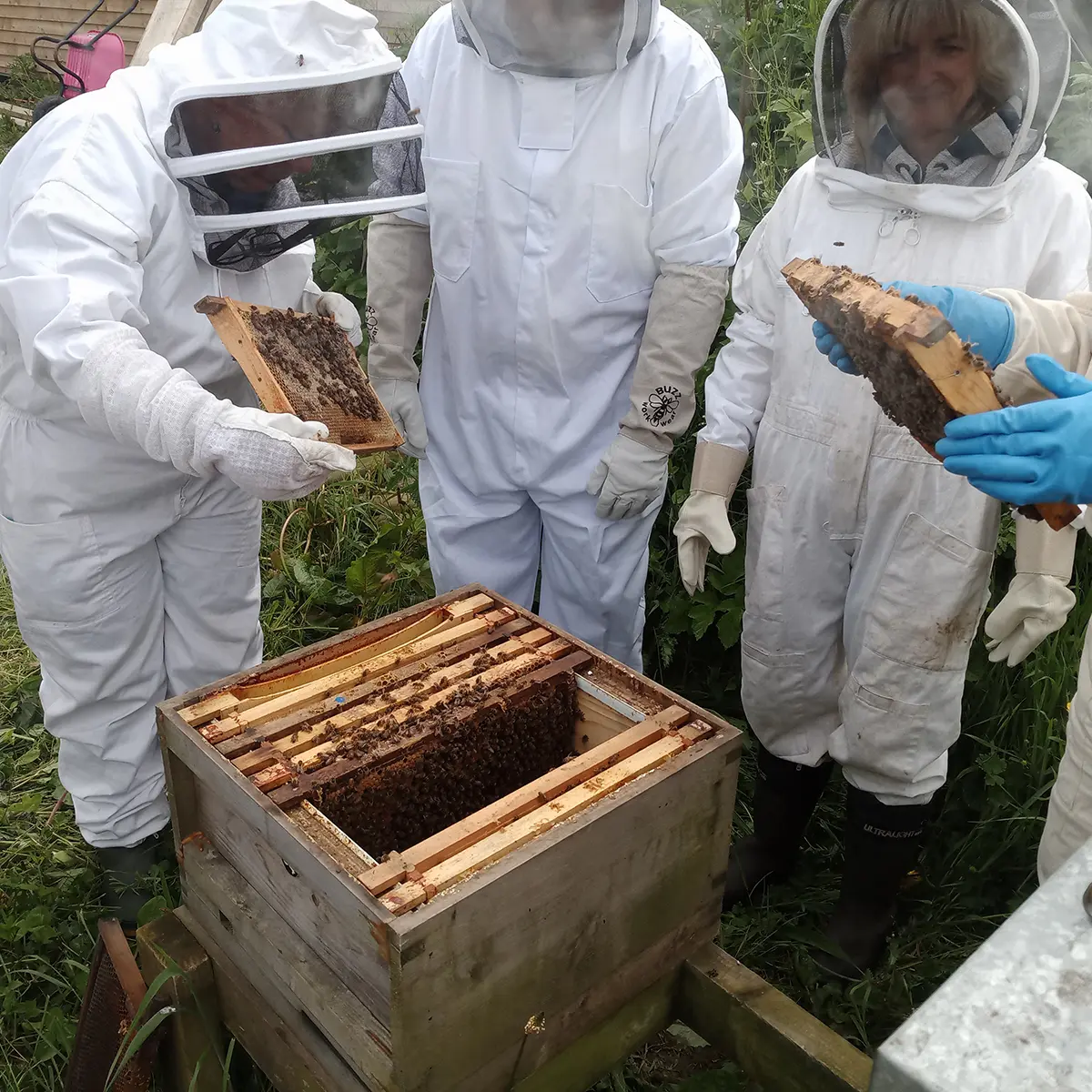
Frames hold the colony’s removable combs. They may contain a starter strip or wax or plastic foundation. Comb is the colony’s working structure: brood, pollen, nectar and honey may all be found on the same frame. Handle frames carefully and keep them in their original order where possible, because the bees arrange their nest for a reason.
The brood nest may occupy one box or more than one, depending on the box sizes, colony and management method. When a box above it is used to collect surplus honey, it is acting as a honey super. Add that storage space in response to a growing colony and a realistic prospect of forage, rather than simply because the calendar says so.
Queen excluder
A queen excluder is a grid designed to prevent the queen entering the boxes above it while allowing workers through. Its most familiar use is to keep brood out of honey supers. It is not a necessary part of every hive; it is a convenience that supports particular management styles and manipulations.
Crownboard and roof
The crownboard is the hive’s ceiling. It sits directly on the uppermost box and makes the close seal that the roof itself usually does not, helping to keep the colony enclosed and pests out. Feed holes or escape ports should be closed when they are not in use.
The roof is the weatherproof cover above the crownboard. It keeps out rain and protects the box edges. A well-fitting, insulated roof can help limit rapid temperature changes and condensation above the colony, but it does not replace the crownboard’s sealing role.
Once you know what each part is for, a hive becomes easier to read. The next step is not buying every available accessory; it is learning whether the colony has the space, warmth, food and dry shelter it needs at that moment.