
-
Oct, Mon, 2026

First Inspections: What to Look For
A first inspection is not a test that you either pass or fail. Its purpose is to begin learning what a colony looks and feels like when it is going about its normal work, and to notice when something needs closer attention. Keep the first visit calm and purposeful. You do not need to find every answer at once.
Before you open the hive
Watch the entrance for a moment. Are bees flying purposefully, carrying pollen, bringing in nectar or making short orientation flights? A quiet entrance is not automatically a problem, and a busy entrance is not automatically proof that all is well. It is simply your first piece of information. Notice the weather too: a warm, calm day makes inspection easier for both you and the colony.
Look for the colony’s overall condition
Once the hive is open, take a moment before lifting frames. Is the colony covering the frames well for the time of year? Does it seem settled, or unusually defensive, noisy or agitated? Are there signs of damp, mold, pests or robbing? The aim is to build a picture rather than react to one isolated detail.
Brood: the clearest sign of direction
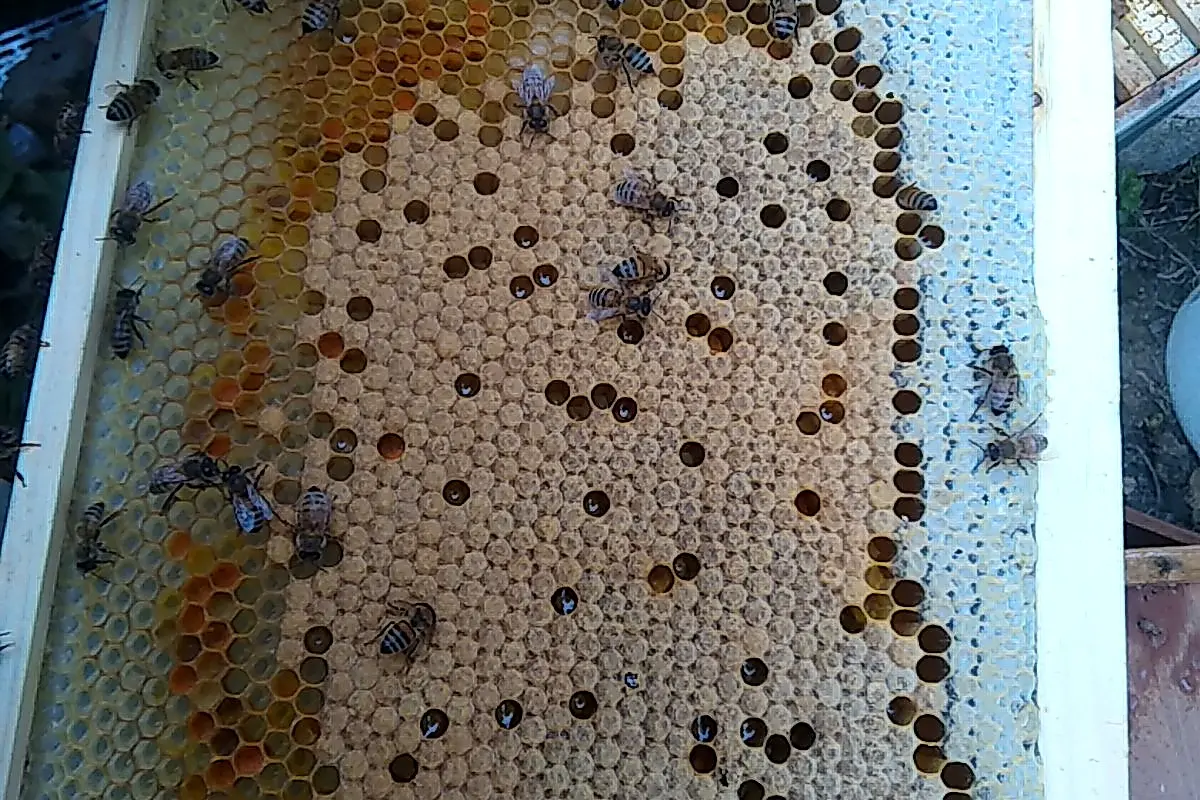
For a new beekeeper, the most useful question is often whether the colony is raising brood in a way that makes sense for its size and the season. Look for eggs, open larvae and capped brood. You do not have to find the queen every time; seeing eggs tells you that a queen has been laying very recently.
A good brood pattern is not necessarily a perfectly solid block. Colonies are living systems, and patches of pollen or stores within the brood area can be normal. What matters is whether the brood looks broadly coherent and whether you can explain what you are seeing. If something appears uneven or unusual, make a note and look again at the next inspection rather than jumping immediately to a conclusion.
Stores, space and comb
Check that the colony has food around it. The amount of honey or syrup stores needed depends on weather, forage and colony size, so there is no single number that suits every hive. Pollen matters too: it is the protein source used to rear brood. Consider whether the bees have enough usable space, rather than simply counting empty frames. A small colony in a large cold box can struggle just as much as a crowded colony can run out of room.
What to record
Keep a short record after each inspection: date, weather, colony temperament, brood stages seen, stores, space, anything unusual and what you decided to do next. A few clear notes are far more useful than trying to remember everything. They let you compare one inspection with another and make decisions from the colony’s own pattern, not just from someone else’s expectation.
Keep the first inspections simple
Try to leave the colony as calmly as you found it. Work steadily, replace frames in the same order and avoid holding the hive open longer than necessary. With experience, you will notice more. At the beginning, the important thing is to become familiar with normal colony activity and to give yourself a reliable basis for asking better questions.
Advice is most useful when it helps you understand the reason behind an action. If someone recommends that you do something, ask what they are seeing in the colony and why that response suits the circumstances. Beekeeping is built on observation and judgment, not on following a fixed script.