
-
Oct, Sun, 2026

Instrumental Insemination: What Is It For?
← Back to Educational Resources
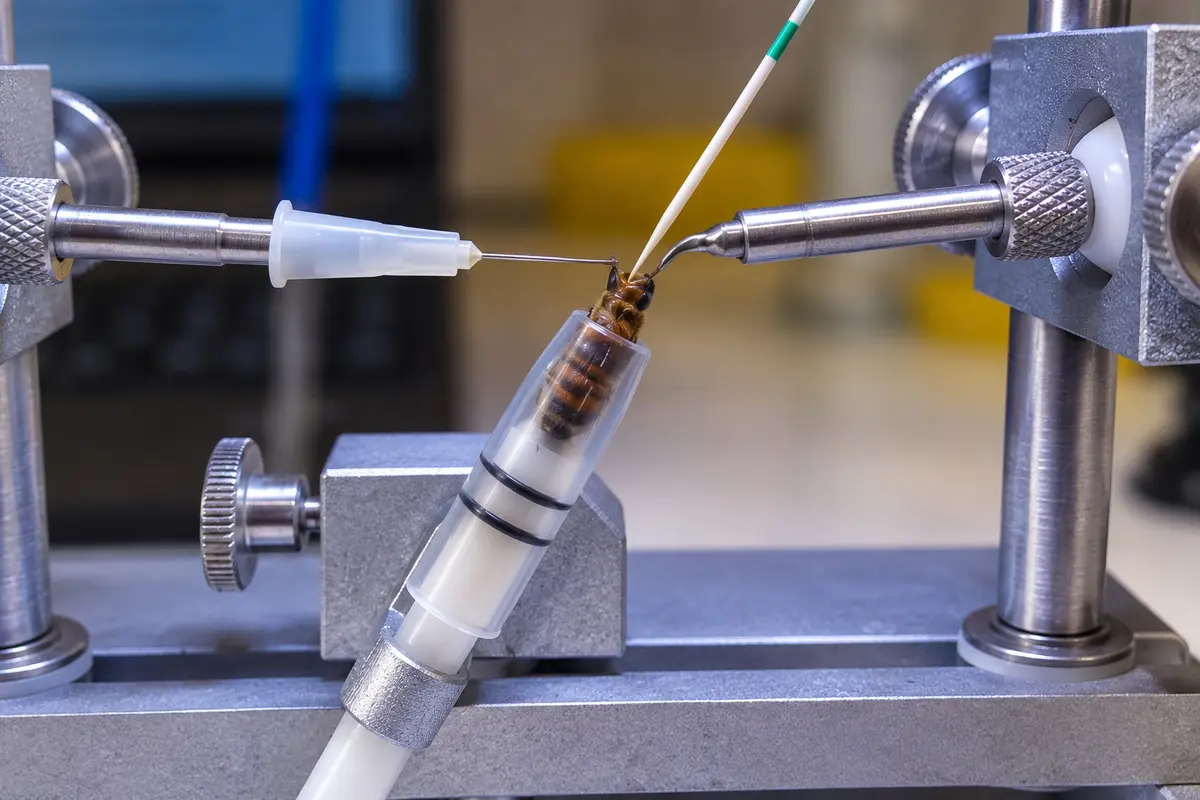
Instrumental insemination is a way of controlling the mating of a honey bee queen. Semen is collected from selected drones and introduced to a virgin queen using specialised equipment. In honey bee breeding it is usually called instrumental insemination because the process depends on careful handling and purpose-built instruments.
It is a breeding tool, not a way to make any queen better by the procedure alone. Its value lies in making the parentage of a queen known, so that a breeding plan can be tested and developed with more confidence.
Why control mating?
With open mating, a queen mates in the air with drones from the local population. That can produce good, useful queens, but the paternal side is largely unknown. Instrumental insemination allows the breeder to choose both the queen line and the drone source.
This makes it possible to create planned crosses, keep particular lines separate while they are assessed, and compare the outcomes of different pairings. It is particularly useful when the aim is to understand inheritance, maintain a breeding population or produce breeder queens with known parentage.
What it can—and cannot—tell you
Known parentage is useful evidence, but it is not a verdict on the quality of the resulting colony. Traits such as temperament, brood viability, health and productivity still need to be assessed in colonies over time and in the conditions where they will be kept. A carefully planned mating does not remove the need to select from the colonies that result.
Nor does instrumental insemination replace open mating in ordinary beekeeping. Open-mated queens can be entirely suitable where the local drone population is appropriate for the breeding aim. The two approaches serve different purposes; the useful choice depends on what the beekeeper is trying to learn or achieve.
What the process involves
Successful instrumental insemination begins well before the insemination itself. It requires suitable virgin queens, a planned supply of mature drones, semen collection, controlled handling of queens and good care afterwards. The equipment and technique are specialised, and small details of hygiene, timing and queen care can affect the result.
For that reason, it is best approached as a complete system rather than a single procedure at a microscope. The genetics, the preparation of queens and drones, the insemination technique and the subsequent assessment of colonies all need to support the same breeding objective.
Using it with a clear breeding aim
Before choosing instrumental insemination, define what you want to improve or investigate. A sensible aim might be to test a particular pairing, preserve a line while it is evaluated, or make breeder queens with a known paternal source. Broad, healthy selection remains important: no mating method compensates for choosing poor source colonies or for overlooking the performance of their daughters.
Instrumental insemination is therefore most valuable when it is used alongside careful colony assessment and records that answer a practical question. Keep the focus on what the resulting colonies show, rather than assuming that the mating method itself guarantees an outcome.
Next read: Instrumental Insemination resources